An atmospheric history of Iceland’s early medical struggles, reformers, and the echoes left behind.

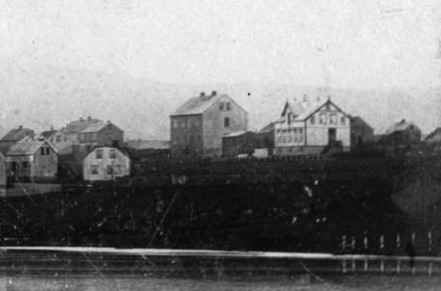
A large timber house crouches at the corner of Þingholtsstræti and Spítalastígur, its dark roof and pale walls watching the slow drift of Reykjavik’s history. Spítalastígur takes its name from this house, Hospital Street, yet the building itself belongs to Þingholtsstræti, named for the elegant home called Þingholt, built in 1765.
A troublesome old hospital
Before this house became a hospital, the city’s sick were tended down by the Althing House on Kirkjustræti 2, where the large Salvation Army building stands today by the corner at Aðalstræti. The old hospital building there also housed the medical school from 1876, with patients tucked away on the upper floor above a restaurant and entertainment hall. It was an awkward, inconvenient place for suffering: illness upstairs, laughter and clinking glasses below.
When the hospital portion of that building was sold for 8,000 Icelandic krónur to a Scottish clothing merchant named Tierney, he moved his shop in, and the sick were pushed out. Reykjavík needed something new, something worthy of a growing town and a modern age.

A “modern” hospital on Þingholtsstræti
By 1884, Reykjavík’s growing needs demanded a new home for healing. Þingholtsstræti 25 became the site of a purpose-built hospital, intended to be the city’s singular institution for medical care, a role it would hold until Landakot Hospital rose in 1902.
On paper it was a symbol of progress, but in reality it looked and felt more like an apartment block than a house of healing. There were fourteen small rooms with space for only about twenty patients, some without any ventilation at all, their air turning thick and stale around bedridden bodies.
There was no proper burner or oven to destroy contaminated clothing or linens from the dead, no safe place to dispose of disease-bearing objects. None of the rooms were bright enough for surgery, and the newspapers openly questioned how this cramped structure could possibly hold both the hospital and the medical school, let alone a bathing room on the top floor. There was nothing designed for psychiatric patients either, no safe place for those whose suffering was of the mind as much as the body.

Dr. Schierbeck’s warning
In 1883, even before the building opened, Medical Director Hans Jakob Georg Schierbeck wrote in the newspaper Ísafold that his purpose, from the moment he took office, had been to secure a proper hospital for the country. He knew that Icelandic medical students needed more than books if they were to become good doctors; they needed to stand at the sickbed, to work with real cases, to touch illness with their own hands. He dreamed of a free clinic for the poor within the hospital walls, where students could help those who could not pay and, in turn, learn their craft.
As both medical director and head of the medical school, Schierbeck believed the Althing’s decision to open a medical school carried a moral duty: to provide the facilities where real training could happen. A hospital, he argued, was not just a building; it was the only place with proper instruments, nursing, cleanliness, and order – the environment where life and death decisions could be made with some hope of success. He insisted that psychiatric patients, too, deserved rooms and care, not to be pushed aside into miserable conditions. Even in distant Þórshöfn in the Faroe Islands, there were four rooms dedicated to such patients, and their hospital was considered better and more sought after than Reykjavík’s.
In 1883 alone, Schierbeck treated 950 patients and performed 65 surgeries; only three patients died, but each operation demanded time and travel as he crossed town to perform surgery in people’s homes, with no dedicated surgical theater to work in. Without such a room, patients waited longer than they should have, and their chances diminished with every day.

A house too small for its purpose
The new hospital on Þingholtsstræti, which should have solved these problems, quickly proved itself unfit. Once the medical school was housed there, only twelve to fourteen patients could be accommodated. The design and location made it nearly impossible to expand, trapping the building in its own limitations. Some rooms had no windows at all; others were so dim that the idea of performing surgery there bordered on dangerous. Patients lay day and night in air that barely moved, in rooms that never truly brightened.
The bathrooms sat on hard “beton” floors with a single bathtub, and water had to be carried in by hand. Bathing was difficult enough that it could only be done under special circumstances; there were no showers, no easy way to maintain cleanliness. There was still no oven to destroy infected clothing and no proper outlet for bodily fluids. Schierbeck worried aloud about the horror of a patient who began to bleed in the middle of the night when no doctor was nearby, in a building where there was nowhere for blood or waste to drain and neighboring houses pressed close around.
He suggested evicting the medical school from the hospital entirely to make room for eighteen patients, and building a separate institution for psychiatric patients with eight rooms and at least two spaces for senior medical students to live. Such a building, he urged, must include an incinerator. By 1884 he spoke plainly: this hospital was, in his view, a failure, and Reykjavík needed to build a proper one. His warnings did not vanish into the air; before long, a larger hospital was indeed raised, as if the town had finally heard him.

A polite disagreement
A few weeks after Schierbeck’s article in Ísafold, another voice entered the public discussion. Dr. J. Jónassen wrote that the hospital, in his opinion, was entirely capable of serving as a proper facility. If the medical school were removed, he argued, the building could hold twenty-six patients, or twenty if the school remained. Four of the bedrooms had windows, and the hallways were windowed as well; ventilation, he insisted, was more than adequate. There was always a doctor on call at the hospital, so if trouble came in the night, help would be there.
While some doctors saw the building as unfit, others pointed to numbers: in the five years prior, the hospital had averaged only sixty patients per year. In October 1884, just two patients arrived; by November, only one. The lack of admissions was blamed on poverty and poor travel conditions rather than the building itself. Complaints about bad air were dismissed by some as nonsense because, they claimed, every room had a window.

The house of the plague
Once both the hospital and the medical school were finally operating, Schierbeck’s wish for a free clinic came to life. There, the poor of Reykjavík could seek help without money, and medical students could learn every part of a doctor’s work, from ordinary examinations to participation in surgery. Such rich, hands-on training was rare in many foreign medical schools, and it gave Iceland’s young doctors a powerful start.
Behind the hospital, in the backyard, stood the morgue, a small outbuilding where bodies were dissected. It measured only about 6.28 meters long, 5 meters wide, and 2.5 meters high, divided into two tight rooms. When the city outgrew the hospital and most patient care moved to Landakot, the building at Þingholtsstræti became, for much of the 1910s, a residential house, its corridors filled with tenants instead of patients. Then, in 1919, it was drawn back into service as a hospital once more, this time with a brutal focus: epidemic disease.
The Spanish flu swept through Reykjavík in 1918, and the city gave the hospital a new, grim name: the House of the Plague (Farsóttuhúsið). At that time, social medicine had no real place in Icelandic politics, and treatment cost money. The poor, numerous in a small town, often could not afford to go. The rich had little desire to seek care in a building with no running water in the rooms and no proper water supply to the surgical spaces. That left mostly the middle class to come through its doors. The conditions may well have helped push Icelandic thought toward the idea of free healthcare, a way to reach the many who could not pay.

A student, a dream, and a body
Among the young men shaped by this place was Jónas Kristjánsson (1870–1960), a student at the Læknaskóli who would later study nutrition and natural medicine and serve in the Althing. He and his classmates were due to sit their exams in January 1901. They managed every part of the examination except surgery, because they had no corpse to practice on.
Time pressed in on them. A ship was scheduled to sail from Reykjavík to Copenhagen on February 12, 1901, carrying them to the maternity ward there to complete their training. If they missed it, they would have to wait until March for the next vessel. One night, as the deadline crept closer, Jónas dreamt he was talking with a fellow student, Andrés Fjeldsted, about the missing corpse. In the dream, a man stepped into their conversation and calmly told them they would receive a body on February 10. When Jónas woke, he told the others. On February 10, a woman’s body arrived from Hafnarfjörður, just as the dream had promised.

Jónas, the healer
From early on, Jónas spoke and wrote about hygiene as a matter of life and death. In a lecture in 1915, he discussed “artificial selection” in humans, clean air, and sanitary living, warning that certain diseases and physical or psychological disorders could pass down through families. By 1918 he was praised as a skilled physician, known for one impressive achievement after another, a man in excellent health and a remarkable athlete.
When he sat for his medical examination on February 11, 1901, Jónas scored 193 points, the highest in his class. His fellow students followed close behind: Andrés Fjeldsted with 191 points, Ingólfur Gíslason with 183, and Þorbjörn Þórðarson with 160.5. Shortly after, they boarded the mail-ship Laura, bound for the maternity ward in Copenhagen to complete their degrees.
By the end of 1902, Jónas had already made a name for himself as a healer. By mid-1903, he urged every doctor to maintain a simple nursing shelter where patients could stay, and pressed the Althing to fund such places. Distances to hospitals were long, the weather often merciless; he believed many lives could be spared if patients could remain close to their doctor, under constant observation and care.
Later, when he founded the Natural Medicine Association, his focus turned to psychosomatic illness and degeneration. He felt that physicians were prescribing too many drugs and that there were better ways to heal. He was known to say that it was too late to cover the well after the child had already fallen into it. Prevention, to him, was as sacred as cure. He was also remembered as an excellent surgeon, a man whose hands could cut to save.
Echoes in the present
Jónas died in the very institution he helped create: the health facility HNLFÍ in Hveragerði (Heilsustofnun Náttúrulækningafélags Íslands). Even after his death, people have claimed to feel his presence. In one modern account, a woman named Magnea describes cleaning a room at HNLFÍ where his belongings were stored and feeling as if Jónas himself lingered there, watching over what he had built.
And so the timber house on Þingholtsstræti, once too small, too dark, and too crude for its purpose, stands as a quiet witness to these lives: to arguments in the newspapers, to the Spanish flu, to young doctors dreaming of corpses and ships, and to a healer who believed that cleanliness, care, and kindness could change the fate of the sick.
Sources:
Jónas Kristjánsson – Facebook thread
Jónas Kristjánsson – Newspaper article 1902
Jónas Kristjánsson – Newspaper article 1903
Jónas Kristjánsson – Facebook thread
Jónas Kristjánsson – Newspaper article 1902
Jónas Kristjánsson – Newspaper article 1903 Jónas Kristjánsson – Newspaper article 1915
Kristjánsson – Newspaper article 1938 Jónas Kristjánsson – Obituary
History of Reykjavík Hospital
New hospital in Reykjavík – Newspaper 1884
Dr. Schierbeck´s concerns about the hospital
Dr. J. Jónassen´s response to Dr. Schierbeck´s concerns
Dr. Schierbeck´s hopes and suggestions for the new hospital
Andrés Fjeldsted