Grýla: The Dark Origins of Iceland’s Christmas Ogress

FrFrightening Christmas Story
Spread the love

“If you don’t behave, Grýla is coming to get you and take you away!”

For Icelandic children, Christmas has a frightening visitor as well as its familiar joys. Grýla is the ogress with a sack, looking for children to carry away and eat. She is a warning parents have passed down for generations.

But the Christmas monster is only one part of her story. Follow her into older tales and the trail leads to troublesome husbands, medieval sagas, and masked visitors demanding food at the door.

The Husbands Who Became Dinner

Frightening Christmas Story section header

Grýla’s appetite was not confined to human children. In the tales of her earlier marriages, even her husbands were not safe.

Her first husband, Gustur, bored her. So she ate him.

Then came Boli. For a time, they were happy together and had several children. Rhymes remember sons named Leppur, Skreppur, Lápur, Skrápur, Langleggur, Leiðindaskjóða, Völustallur, and Bóla. These are not the sons most people think of at Christmas.

According to the story, Grýla eventually grew tired of Boli too. He met the same end as Gustur.

A Household of Monsters

Her third husband is Leppalúði, a lazy fellow with little going on in his noggin. In this account, they have twenty children, thirteen of whom are the Yule Lads.

Those thirteen mischievous visitors became part of Iceland’s Christmas tradition. Their parents’ domestic life, however, was far less cheerful.

While Grýla Lay Ill

One tale tells of a year when Grýla was too ill to leave her bed. Leppalúði, unwilling to care for her himself, hired a woman named Lúpa.

While Lúpa looked after Grýla, she and Leppalúði had an affair. Before Grýla recovered, Lúpa was pregnant.

The Child Under Her Roof

Lúpa gave birth under Grýla’s roof. She and Leppalúði named their son Skröggur.

When Grýla finally climbed out of bed, she discovered what had been happening while she lay ill. She threw Lúpa and Skröggur out.

This is not the household most children hear about at Christmas. Behind the familiar ogress lies a much larger, stranger family history.

Can Grýla Ever Die?

Some verses offer children a little comfort: Grýla and Leppalúði have starved because all the children were good. There was nobody left for them to eat.

But the reassurance comes with a warning. If children misbehave again, the monsters can return.

Grýla is difficult to put to rest. Her name reaches back into medieval literature, long before the Christmas figure most of us recognize today.

A Name Older Than Christmas

One early literary appearance of the name is in Sverris saga, one of the kings’ sagas. Grýla also appears as an ogress in the thirteenth-century Snorra-Edda.

These references take us beyond Christmas. They also raise a question: what did Grýla’s name mean to the people who first encountered it?

King Sverrir Sigurdsson

Sverri’s saga is the biography of King Sverre Sigurdsson of Norway (c.1145/1151-1202). When he became the king in 1177, he was the leader of the rebel party, Birkebeiner.

The first part of Sverris saga is called Grýla. Several explanations have been offered for the name; it should not be mistaken for a straightforward account of the Christmas ogress.

One interpretation connects it with a threat that frightened people but might ultimately come to nothing:

Flateyjarbok

Flateyjarbók - Largest Icelandic medieval manuscript

"People called the first part of the book Grýla because many believed that worry or fear to do with great wars or battles might arise, but that it would then quickly fade away and vanish into thin air, as it reasonable could be expected to in view of the strength and superiority of what was facing."

"People called the first part of the book Grýla because many believed that worry or fear to do with great wars or battles might arise, but that it would then quickly fade away and vanish into thin air, as it reasonable could be expected to in view of the strength and superiority of what was facing."

An Outlaw’s Life on the Margins

Norways king sagas

The saga’s world was harsh. Sverrir and his Birkebeiner followers lived as outlaws in the heaths and woods, struggling to find food. The account describes them eating bark, drinking sap, and searching beneath the winter snow for berries.

That threatening life on the margins is one explanation offered for the name Grýla. It is an interpretation of the saga’s title, rather than proof of how the Christmas legend began.

King haakon

King Haakon Haakonsson

King Haakon Haakonsson was Sverri's grandson. When Haakon was two years old, the Birkebeiners saved his life by escaping with him through treacherous territory and into Trondheim.

Lillehammer coat of arms

Lillehammer Coat of Arms

It depicts a Birkebeiner skiing in honor of the rescue. The depiction of the Birkebeiners carrying Prince Haakon to safety during the winter of 1206 has become a national icon in Norway.
The prince grew up to be King Haakon IV whose reign marked the end of the period known as the Civil war era in Norway.

Sverrir's children Haakon and Kristin

Kristin and Haakon

When The 1994 Winter Olympics were held in Lillehammer, there were two mascots: Håkon and Kristin. They were named after king Sverri's two children.

When Hungry Men Became Monsters

In these accounts, the boundary between a desperate human being and a frightening creature becomes blurred. Sverrir’s followers wore ragged coverings of skin and bark; their arrival meant hungry men seeking provisions.

The article’s sources compare this threatening outsider with mountain beings such as Fingálpn and the julebukk, which came down to the settlements and demanded offerings. The resemblance is suggestive, but it does not establish a single origin for Grýla.

frightening christmas story

The supernatural monster

The Archbishop, Eysteinn Erlendsson in Österdalen, warned the farmers about Sverrir and his fellow vagabonds coming to take their food supply. So not without surprise, for the common people of the Norwegian settlements Sverrir was a supernatural monster which transformed into a human at will. How is that for a frightening Christmas story?

A Knife, a Bag, and a Warning

Iceland is not the only place where such a visitor frightened children. In Faroese tales, Grýla comes down from the mountains carrying a large knife.

Here, she seeks children who cry because they have not been given meat during Lent. What happened after she caught them was left to the imagination. The season differs from Iceland’s Christmas tradition, but the warning feels familiar.

faroe islands

Saksun village - Faroe Islands

A known Grýla verse from Faroe Islands:

Down comes Grýla from the outer fields
with forty tails.
A bag on her back, a knife in her hand,
coming to carve out the stomachs of the children
who cry for meat during Lent.

An Ogress Across the Northern Isles

Related figures appear in the traditions of Foula and Unst in Shetland, the Faroe Islands, and northern Norway. One name is Skekla, an ogress, which resembles the Icelandic word skessa.

Other names include skekel, jólaskekil, and joleskjekel. Their similarities offer a way to explore connections between these traditions. They do not, on their own, tell us exactly how one figure developed into another.

Grýla/Skekla verse from Shetland Islands

Skekla (an ogress) rides into the homefield
on a black horse with a white patch on its brow
with fifteen tails
and fifteen children on each tail.

Strangers at the New Year Door

frightening christmas story

In Art Rambles in Shetland, John T. Reid describes disguised New Year visitors collecting provisions for a feast:

“In the olden time, on the last night of the old year, five young lads, consisting of a “gentleman”, a “carrying horse” and three others, all disguised, went from house to house, singing what they called a “New’r Even’s Song” and collecting provisions for a banquet on New Year’s Night.

The “gentlemen” wore a cap made of straw with his name lettered on the front, a collar of straw around his neck, a belt of straw around his waist, and a band of straw around his right arm. It was his duty to sing, which he did standing outside the door, and when the song was finished, if invited, he would enter the house, and introduce himself as Vanderdigan come from Drontheim, pronounced Dronton“

Art Rambles in Shetland by John T. Reid.

A Halloween Encounter

frightening christmas story header

A more unsettling encounter appears in Robert Menzies Fergusson’s account of Orkney and Zetland. A fellow traveller told him about strangers who had appeared one Halloween. Before their purpose became clear, the visitor was terrified.

The Kitchen Full of Strangers

“…I saw the kitchen literally full of beings, whose appearance, being so unearthly, shook the gravity of my muscles, and forced the cold sweat to ooze out of every pore in my body. There they stood like as many statues, one of whom was far above the rest, and of gigantic dimensions. Eyes, mouths, or noses had they none; nor the least trace of countenance. They kept up an incessant grunt, grunt, grunt or a noise partly resembling swine or turkey cocks.

Faces Hidden Beneath Straw

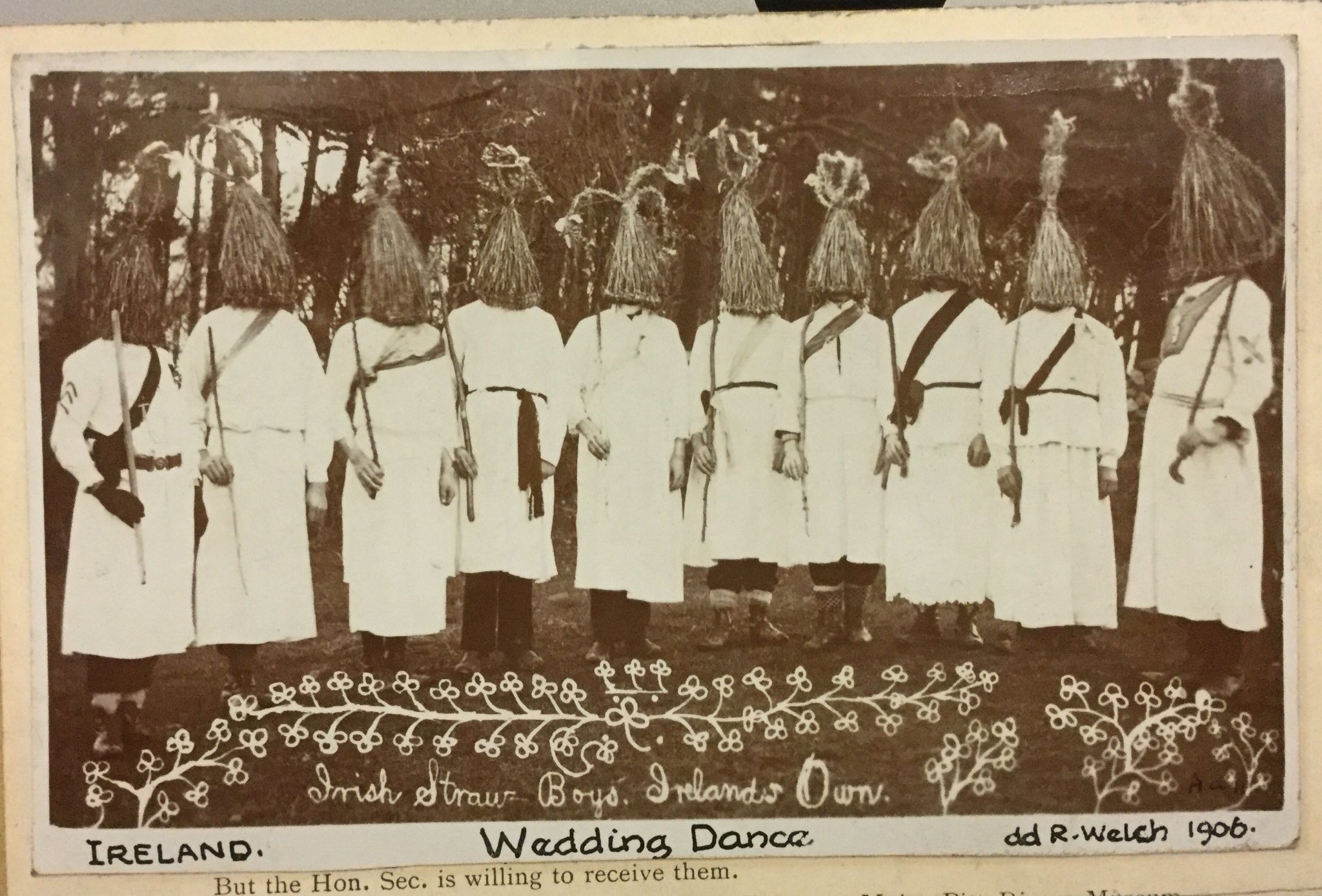
Their outer garments were as white as snow, and consisted of petticoats below and shirts on the outside, with sleeves and collars. They were all veiled and their head dresses or caps were about eighteen inches in heights, and made of straw twisted and plaited. Each cap terminated in three or four cones of a crescent shape, all pointing backwards and downwards, with bunches or ribbons of every colour raying from the points of the cones.

The spirits for such they appeared to be, had long staves, with which they kept rapping on the floor. Between them and the door stood one as black as ´Horni ;´but more resembling a human being than any of the others. His head dress was a South-wester, and he had a keshie [a bag made of straw] on his back. My landlady by this time had considerably recovered and the sight of the keshie tended greatly to allay our doubts, and we all ventured into her kitchen.

What the Visitors Wanted

“Immediately upon entering the kitchen they formed themselves in pairs and commenced hobbling and dancing. When asked what they wanted the keshie was presented; and in it was a piece of mutton and other eatables. Their chieftain, or leader, muttered in a disguised and guttural tone of voice, that they would take anything we chose to give them.

My landlady gave them some mutton and oatcakes, with which they appeared highly elated and returned thanks with bows and curtseys: but still kept up the incessant grunting. Before leaving the house, however, they inquired of me, in the same guttural tone of voice, if they should go to the Minister’s. “Certainy,” said I: “be sure you go there, and give him a specimen of your dancing: for the minister is a very liberal gentleman and will, I doubt not, fill your keshi.


A Feast After the Fright

“Such is a description of what was common enough some thirty years ago in the Far North. When a band of guizards have had a fair night’s work they generally assemble at some rendezvous, where all the good things are disposed of in a festive manner. The leader of the gang is known by the name of “Scuddler” while the one with satanic appearance is called Judas.” Rambles in the far north by R. Menzies Fergusson


When the Monster Joined the Party

frightening christmas story
Vikivaki is a traditional dance (a story dance) which existed as far back as the 11th century.

These encounters lead from stories about monsters to people dressing as them. Scandinavian julebukk customs and Icelandic vikivaki games provide further comparisons.

In the Christmas gatherings described here, the julebukk entered the living room during the days between Christmas and New Year. The frightening visitor was now part of the festivities.

The Goat at the Gathering

People gathered to drink, play games, and celebrate. Into the room came a young man disguised as a goat, carrying a goat’s head on a stick and wearing its coat.

Some accounts also describe a wooden hammer resembling Thor’s hammer. Such details invite comparison with older beliefs, although a resemblance is not proof of an unbroken pagan tradition.

A Creature That Died and Danced Again

The julebukk frightened children and adults alike, asking who had been good and who had been naughty. It jumped and danced while the company sang.

In the version described here, the goat dropped down dead, then returned to life as the song continued. The article associates this with Thor’s animals; that connection belongs to the interpretation of the custom.

Other versions took the visitor from house to house. The person inside the costume disguised their voice, and the household tried to guess who it was.

Songs, treats, and the effort to discover the stranger’s identity became part of the game. The monster at the door could also be a neighbour.

Straw, Seaweed, and Animal Skins

This is a photo from 1898 of a family at "Cilles hus" in Midvåg, Faroe Islands. The entire house consists of one room with two beds. One can only imagine how scary these costumes must have been for the children. The homes were cold and dark.

In Faroese and Shetland costume traditions, frightening figures wore tattered animal skins, straw, or seaweed. They visited farms and villages demanding offerings.

In the Faroese tradition described here, the offerings were called grýlubita. The visitors appeared on grýlukvöld, Grýla’s Eve, during Lent.

Svabo’s Dictionarium færoense describes grujla as a costumed figure or bogeyman used to frighten children at Lent. The related word grȗiliur means “abominable.”

One description gives the creature a seaweed coat trailing like a tail, a rusty black hook in each hand, and a large skin bag on her back. It is a different appearance from the familiar Icelandic ogress, but the bag and the threat are recognizable.

Grýla’s Many Disguises

frightening christmas story
Up-Helly Aa festival in Lerwick

Older Shetland customs also brought disguised visitors from door to door. On Unst, they were known as gröleks.

The sources record many spellings: gröli, grölik, grulek, gruli, grulick, grulja, grulik, and grillock. This family of names is part of the comparison with Grýla.

The Shetland Skeklers

frightening christmas story header
Skekling is an old Shetland folk tradition. A Skekler is the name for a type of disguised person dressed in a distinctive straw costume; it is a variant of the term ‘guiser’. Skeklers would go round the houses at Halloween, New Year, and turn up at weddings in small groups performing fiddle music in return for food and drink. It is believed that this fascinating custom had all but died out by 1900 and the children in the old photograph were actually part of a ‘squad’ dressed as Skeklers as part of the Up Helly ‘A festival.

The Uninvited Wedding Guests

The visitors did not appear only at Christmas or New Year. Art Rambles in Shetland also describes their arrival at a wedding:

“About nine o’clock, commotion and whispering being observed amongst those nearest the door, the fiddler stops, dancing ceases and the “honest man” informs the company that the “guisers” have arrived.


The Scuddler Enters

On the best man announcing that there is plenty of both meat and drink for all comers – five gallons of whisky it may be yet untouched – the fiddler is told to “play up the guiser’s spring” when in walks a tall slender-looking man, called the “scuddler”, his face closely veiled with a white cambic napkin, and on his head a cap made of straw, in shape like a sugar-loaf, with three loops at the upper extremity, filled with ribbons of every conceivable hue, and hanging down so as to cover the cap.

He wears a white shirt with a band of ribbons around each arm and a bunch of ribbons on each shoulder, with a petticoat of long cleans straw, called “gloy” which hangs loosely. The moment he neters he gives a snore and having danced for a few minutes, another enters, called the “gentleman”, somewhat similarly attired: he too, having danced, a third, called the “fool” appears and so  till all are in.


Who Was Behind the Disguise?

And it is really a strange sight to see six tall young men dressed thus fantastically, and dancing with so much earnestness. They are careful to speak not a word lest they reveal their identity: and not a sound is heard but the music of the fiddle, the rustle of the straw petticoats, the thud of their feet on the earthen floor, the laughter of the “fool” and the whispers of the bride’s maidens guessing who the guisers may be.”

A Voice Nobody Recognized

frightening christmas story header

The disguise extended to the voice. Like the Faroese figures and Scandinavian julebukker, Shetland’s visitors avoided speaking normally so that nobody would recognize them.

They grunted like animals and spoke while drawing breath inward. Once invited inside, they gathered the company around the fire and danced.

"Trick or Treat"

It is also noteworthy that, like the Faroese grýlur and mainland Scandinavian julebukker, the gröleks and the skeklers used to demand some form of offering when they made their visits, most particularly meat. They gave nothing in return.

supernatural being

Finngálkn 

Finngálkn (which is what the julebukk was considered to be) is a mythical creature you hear about in many ancient sagas. They move around like a chimera and are usually a mix between human and animal. þingálp(n) is connected to or derived from Finngálkn. 

The article’s sources also compare skekler with the Old Icelandic skekill, referring to the shanks or legs of an animal skin when stretched out. These word connections are part of the research trail, rather than a settled family tree for the monsters.

The Ogress With a Goat’s Body

frightening christmas story headline

The Faroese Grýla and Grylen associated with Svínoy offer another comparison. One description gives the figure a goat’s body, walking upright like a person.

Here, the resemblance is closer to a julebukk than to the woman-shaped ogress familiar from Icelandic Christmas tales.

Julebukk

The Shetland word grölek originates from the word grökle which is related to the julebukk in Kviteseid, Norway. Similarly, the word skekler relates to the Norwegian word kveldsjögl/kveldsgjögla. This word was synonymous to julebukk figures in Nissedal and Vest Agder. They also used the word skulkar for party gate-crasher. 

What the Masks Cannot Tell Us

frightening christmas story header
A mask found rolled in a ship discovered in a harbor in Hedeby

The two masks found aboard a ship at Hedeby add a final, uncertain piece to this wider history of disguise. They had been reused as caulking.

The red felt mask pictured here has been interpreted as an animal, perhaps a dog, sheep, or fox. Its original purpose is uncertain. Suggestions include performance, ritual, or disguise.

It is tempting to connect it with the monsters in these stories. But the mask cannot, by itself, tell us whether its wearer was a performer, a ritual participant, or something else.

The Ogress Who Keeps Returning

Grýla’s story does not follow a single tidy path. There is the hungry ogress, the name in a medieval saga, and the masked stranger arriving at the door. Their connections are worth exploring without pretending every link is certain.

At Christmas, the story comes back to the warning Icelandic children know: behave, or Grýla may come for you. The older tales make her stranger still.

Continue with the Grýla poem, Part 1 and Part 2, or meet the thirteen Yule Lads.